
AthensLive Wire 293:
„Februar 2025: Als die Griechen die moderne Geschichte ihres Landes schrieben
…Griechenland befindet sich in einer noch nie dagewesenen Krise der politischen Vertretung.
…Es gibt keine soziale Bewegung. Es gibt nur eine politische Kluft, eine gefährliche Kluft, eine Krise der politischen Vertretung.
…Am 28. Februar, zwei Jahre nach dem tragischen Zugunglück, bei dem 57 Menschen ihr Leben verloren, strömten die Bürger im ganzen Land und im Ausland auf die Straßen und Plätze, um Gerechtigkeit für Tempi zu fordern. Die Dachgewerkschaften GSEE und ADEDY sowie das Athener Arbeitszentrum riefen zu einem landesweiten Streik auf, dem sich Beschäftigte des Gesundheitswesens, des Bildungswesens, der Schifffahrt, des öffentlichen Nahverkehrs, des Kultursektors usw. anschlossen.
Das ganze Land kam praktisch zum Stillstand.
Insgesamt waren in 365 Städten in Griechenland und im Ausland Versammlungen mit hoher Beteiligung angesetzt.
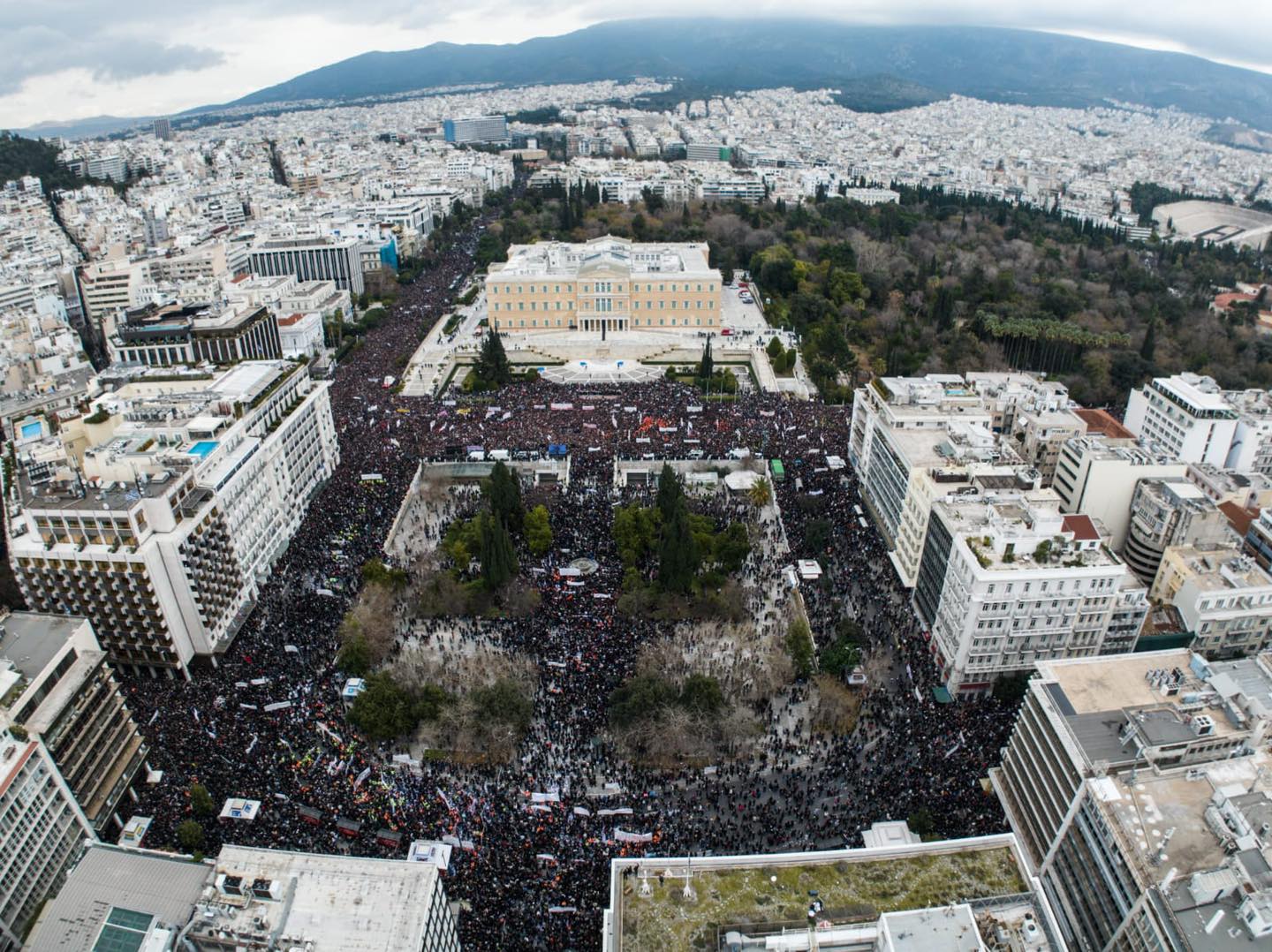
Schätzungsweise 700.000 bis 1.000.000 Menschen versammelten sich allein in Athen, so dass dieser Protest nur mit einigen monumentalen historischen Momenten des Landes vergleichbar ist – nach dem Sturz der Junta im Jahr 1974 und nach der Befreiung der Stadt von den Nazis im Jahr 1944.
Trotz der dichten Menschenmenge (oder gerade deswegen), unter der sich auch Kinder und ältere Menschen befanden, warf die Polizei Tränengas und Blendgranaten. Dennoch gelang es ihnen nicht, die Stimmung zu brechen.
Das war riesig. RIESIG.
Ich war auf dem Syntagma-Platz.
Ich nehme schon seit 30 Jahren an Kundgebungen teil. Ich habe an allen großen und vielen kleineren Protesten teilgenommen. Außerdem bin ich seit mehr als 20 Jahren als Journalist tätig. Ich kann mich nicht an eine Kundgebung in Athen erinnern, die von der Größe her mit der vom 28. Februar vergleichbar gewesen wäre. Nicht einmal während der Bewegung der Plätze im Jahr 2011. Nicht einmal am Vorabend des Plebiszits vom 5. Juli 2015, als die Menschen der Macht die Stirn boten und massenhaft mit „NEIN“ gegen die Memoranden stimmten. Jene Memoranden, die zu den Sparmaßnahmen führten, die nun die Infrastruktur des Staates lahmlegen und das Land und seine Bevölkerung verarmen lassen. Jene Memoranden, die letztendlich zu dem Zugunglück von Tempi geführt haben, wie der unabhängige Bericht belegt, den wir im nächsten Abschnitt analysieren.
Am 28. Februar 2025, zwei Jahre nach dem Zugunglück von Tempi, war die Demonstration so groß, dass sie nur mit Protesten in Epochen verglichen werden konnte, die meine Generation nicht erlebt hat. Ältere Menschen und Experten vergleichen sie mit der Kundgebung nach dem Sturz der griechischen Junta im Jahr 1974, bei der die Menschen skandierten „Gebt die Junta dem Volk“. Und mit der Freudendemonstration, als die Menschen nach der Befreiung Athens von der Nazi-Besatzung im Jahr 1944 die Straßen überfluteten.
[ab hier die Originalversion]
Mainstream Mega Channel estimated the crowd to be 800,000 people.
Massive rallies, scheduled for 11 am (Greek time), were held in 365 cities in Greece and abroad. Thessaloniki also saw one of the largest protests in its history.
Shops were closed, hairdressers were closed, even big supermarket chains like AB closed for a few hours, coffee bars and taverns were closed, ‘bouzoukia’ were closed.
Taxi drivers were on a 24-hour strike, yet some 400 were on duty only to pick people up from specific spots in Athens to take them to the demonstration. You could spot them from the black balloon tied to their window, writing ‘I have no oxygen’.
Even prisoners sent a message of solidarity to the protesters, stating they know “first hand what Greek justice and a cover-up means, what justice and police acting arbitrarily means.”
These are unprecedented things. They have never happened before altogether, at least not in my lifetime.
As we mentioned, public transportation was on a 24-hour strike. Only the metro operated for a few hours to help demonstrators commute, but the police, according to their thirteen years of practice, have shut down crucial metro stations close to the city centre.
Despite everything, people reached the heart of Athens to protest. On foot, most of them. They walked, even from Athenian neighbourhoods many kilometres away from the centre. Roads turned into rivers that flooded Syntagma square. Syntagma means ‘Constitution,’ so Greeks tried to uphold it symbolically.
All of them. Women and men, older and younger. I saw people with walking sticks, people in wheelchairs, and babies in their buggies. I saw people dressed in suits, in alternative clothing, in tracksuits, on heels, with trainers.
„I am addressing the murderers of our children. You insulted and showed contempt for our dead. The remains and bones of our children lie unburied in hidden places. You have committed the greatest hubris, and you will receive what is due through the pulse of Nemesis,“ declared Maria Karystianou, head of the Tempi Victims’ Relatives Association, speaking in Syntagma square.
She reminds me of ancient Greek tragedy heroines, fighting to uphold eternal values so often forgotten through the centuries by the people in power.
“Murderers, Murderers” people chanted.
Meanwhile, 25 members of the anarchist collective Rouvikonas had climbed on the rooftop of Hellenic Train headquarters and opened a banner with “Murderers” written on it. All 25 were arrested and now face charges of disturbing domestic peace.
The crowd in Athens was most dense in front and around the Parliament – that is, around Syntagma square.
This is where the police hit.
A small hooded group started smashing and breaking marbles in Syntagma. The police were just watching them do it, they let them do it. Then, they threw tear gas and flash grenades to disperse the crowd.
These hooded groups appear in most demonstrations. I have never witnessed the police stopping them or arresting them. They play a pivotal role in creating panic and ‘triggering’ police intervention. This has been a pattern for decades. Many believe these are groups infiltrated or even incited by the police. Evidence has surfaced from time to time showing cooperation at least with some of them . … Whether these groups are incited or not, they definitely create chaos that turns against the crowd. Plus, they have never acted in solidarity with the rest of the protesters – kids, elderly, and people with mobility problems were also participating in this rally.
At the same time, police on motorcycles (the ‘DIAS’ unit), in groups of ten-twelve, were speeding through the crowds with a clear intent to intimidate people. Some even waved their truncheons against us to flaunt their power.
A total of 84 detentions and 41 arrests have been made in Athens.
The photojournalist of the Athens-Macedonian News Agency (ANA-MPA), Orestis Panagiotou, was injured
in the head by a stun grenade thrown by the police. Veteran photo-journalist Marios Lolos -himself a victim of police violence- that Orestis Panagiotou suffered a head injury from the stun grenade and that he was discharged from the hospital with reduced hearing after receiving stitches.
Despite the crackdown by the police, protesters kept coming back to Syntagma and surrounding streets. For quite some time, they were just sitting peacefully and chanting „Resign.“
Police attacked again at 16:15 using a water cannon, tear gas, and flash grenades to disperse them.
At exactly 23:18, the time when the Intercity train collided with the freight train in Tempi two years ago, demonstrators at Syntagma, who were holding candles, released white balloons into the sky in memory of the 57 victims of the railway disaster.
Each balloon bore the age of one of the victims.
“Immortal,” they chanted.
Why so big, why now, what next
The whole of Greece is Tempi – and potentially Tempi. In a nutshell, the accident has become a painful emblem of the country’s vital infrastructure’s gradual collapse following fifteen years of austerity policies and decades of corruption.
People in Greece often say that only pure lack keeps us alive. After all, it was pure luck that we were not on that train. Be it trains or other transportation means, be it collapsing obsolete hospitals and school buildings, the understaffing of vital institutions and services -and so on- citizens’ lives are at risk every minute.
Tempi, and the subsequent unprecedented cover-up attempt, was the straw that broke the camel’s back.
That’s also because in this country no state or other high ranking official has ever been punished for major scandals through the decades – with a handful of exceptions verifying the rule.
In alliance with mainstream media, the government pulled out all kinds of tactics from their propaganda machine to make people refrain from the 28 February demonstration (we analysed part in our previous newsletter). They used the carrot and the stick. First, they tried to intimidate citizens by spreading rumours of violent episodes. They engaged in unprecedented newspeak, with ministers and organic intellectuals declaring in all tones that an effort to destabilise the country is underway (by protesting!) Then they patted people in the back by saying that demanding justice is legit. Then, they tried to intimidate us again.
It was the very same propaganda style used back in 2011 and 2015. It can be enshrined in the fake dilemma “Memoranda or Chaos”, “Mitsotakis or the End of the World” – “Choose the status quo or descend into the abyss.”
Well, it did not work. Instead, it worked the other way around: The more the people were subjected to this manic campaign, the more decisive they became.
After having green-lighted party officials to make provocative statements, PM Mitsotakis attempted to appear as a unifying figure with a post on social media on the day of the protest. In this, he referred to „human errors“ and „chronic failings of the state“ but failed to undertake responsibility for his government’s role. “All Greeks share the grief, united by a common demand for truth and justice,” he said. Yet he once again targeted the opposition, accusing them of „political exploitation of human suffering.“ Also, he indirectly reiterated the narrative that a potential fall of government would equal ‘destabilisation’ of the country: the majority of the citizens -he said- share the view that “a tragedy that has deeply hurt us should not become a tool for others to undermine national unity or derail the steady course toward a better future.”
Mitsotakis indeed united the Greeks. He united them against his government. After this historic demonstration, in which people from all across the political spectrum participated, one thing is for sure:
The New Democracy government and Prime Minister Kyriakos Mitsotakis are now politically and ethically delegitimised.
So, what next?
Greece is going through an unprecedented crisis of political representation.
People are deeply disappointed both by the government and the opposition – the latter being fragmented and essentially voiceless in Parliament (in the sense they either have enforced or support similar policies or do not express a strong and persuasive opposition stance.)
At the same time, there is no social movement. A big social movement developed back in 2011, which culminated in the Squares movement. There were thousands of neighbourhood collectives, solidarity and self-organised initiatives, building a political alternative to the Memoranda.
This movement brought a 3% party -SYRIZA- to become the government.
Then, we all know what happened. SYRIZA degenerated to a TINA party and kept enforcing the austerity policies despite the fact that people had elected them exactly to avert this.
The movement then died.
So, now there is no political party that people can widely trust. There is no social movement.
There is just a political gap, a dangerous gap, a crisis of political representation.
We cannot stop thinking of the following scenario:
Mitsotakis declares elections. ND again gets a big part of the vote, not enough to become government. So, they then forge a coalition with the far-right.
However, action sometimes brings solutions we had not imagined before.“


 griechenlandsolidarität